
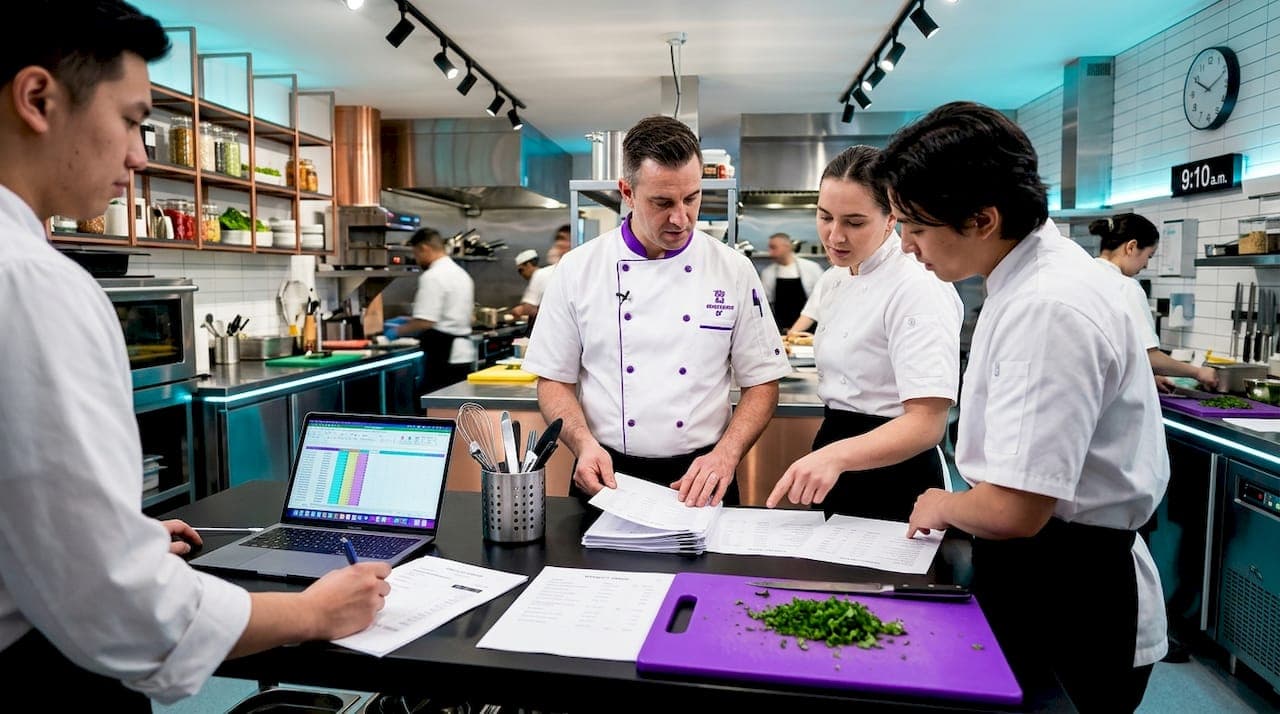
When you price a multi-course event by adding up raw ingredient costs and calling it done, you're leaving money on the table. Every experienced caterer knows that feeling: the event runs smoothly, the food looks great, and then the final numbers come back thinner than expected. The reason is almost always the same. To truly streamline multi-course event food costing, you need to account for labor allocation, holding windows, re-fire risk, spoilage, and portion variance. These aren't edge cases. They're the difference between a profitable event and one that just breaks even.
Table of Contents
- Key takeaways
- What multi-course food costing actually involves
- Preparing before you start costing
- How to calculate multi-course event food costs step by step
- Common mistakes that erode your margins
- Verifying efficiency and improving future events
- My take on where multi-course costing really breaks down
- How Cookx makes event food costing faster and more accurate
- FAQ
Key takeaways
| Point | Details |
|---|---|
| Go beyond raw ingredients | True food cost includes labor, holding time, re-fire risk, trim, and spoilage at every course. |
| Start with solid assumptions | Set guest count early, budget at 80% projected attendance, and build in a 10–20% contingency. |
| Use course-by-course costing | Build each course separately with real purchase units to catch pricing gaps before the event. |
| Apply a food cost percentage floor | Target 28–35% food cost and divide raw cost by that percentage to find your price floor per head. |
| Reconcile after every event | Post-event data is your most valuable tool for tightening future multi-course meal pricing. |
What multi-course food costing actually involves
Most event planners think about food cost as a plate problem. Add up the proteins, the starches, the garnish, and you have your number. But multi-course meal pricing must include labor allocation, holding-window management, and re-fire costs to avoid margin leaks. The plate is just the starting point.
Here is what a complete cost picture actually looks like for a multi-course event:
- Labor allocation per course: Labor is not a fixed overhead number you sprinkle evenly across dishes. A seared scallop appetizer served to 200 guests requires meaningfully more station time than a pre-plated salad. Assign labor by course complexity and service timing.
- Holding window costs: Hot dishes held past their optimal window either degrade in quality or require re-firing. Both outcomes cost money. A dish held 20 minutes too long creates a choice: serve something subpar or absorb the cost of remaking it.
- Re-fire risk: This is the cost most caterers ignore until it bites them. Re-fire risk modeling uses a matrix per main dish with thresholds at 1%, 3%, and 5% re-fire rates to quantify the exposure. At a 200-person dinner with a 3% re-fire rate on the main course, you're remaking six plates. That's ingredient cost plus labor plus station time.
- Trim and spoilage allowances: Raw proteins lose 20–30% of their weight through trimming and cooking. If you price a beef tenderloin at its purchase weight without accounting for yield, your cost per served ounce is significantly higher than you think.
- Portion variance: Buffet formats generate more consumption variance than plated service. Guests at a buffet take irregular portions, and popular dishes run out faster than expected. Plated service controls portions but introduces its own waste from uneaten courses.
Pro Tip: Build a re-fire liability table for every hot main dish before the event. List the dish, the re-fire time in minutes, and your threshold percentage. If re-fire time exceeds six minutes, that dish carries elevated labor and station cost risk that needs to be priced in.
Food and beverage costs often represent 40–50% of corporate event budgets. Getting multi-course food costing wrong does not just affect one line item. It affects the entire event's profitability.
Preparing before you start costing
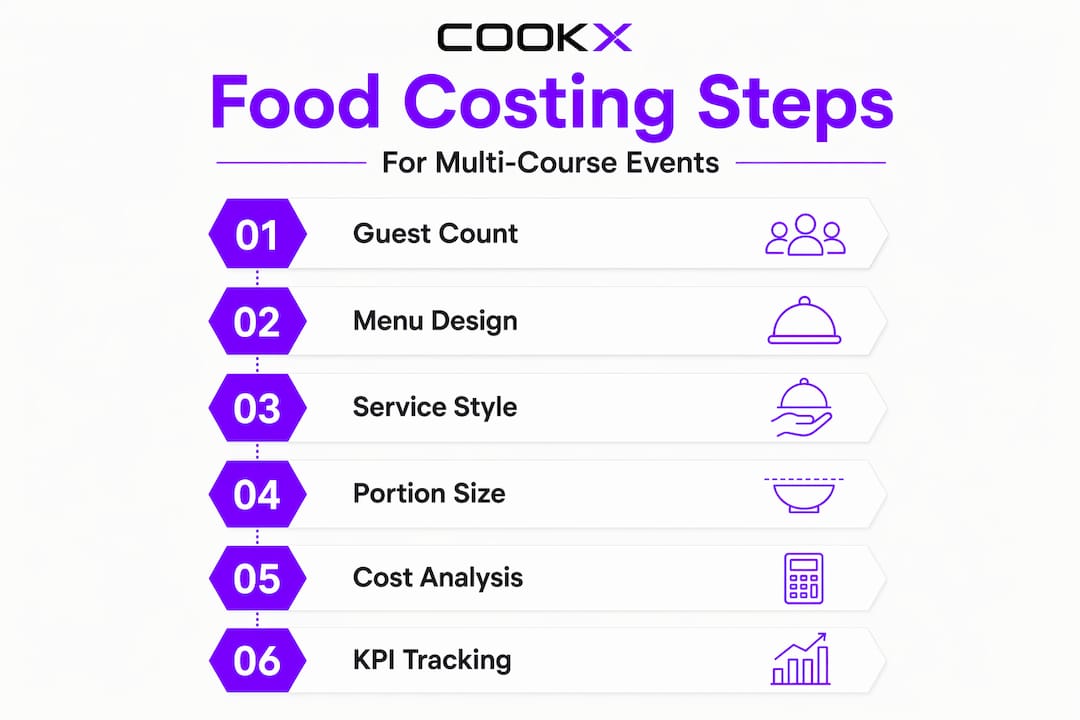
Accurate multi-course event food costing does not begin with a spreadsheet. It begins with decisions made weeks before the event that determine how reliable your numbers will be.

Guest count assumptions matter more than most planners admit. The single biggest source of food cost variance is not ingredient pricing. It's the gap between projected and actual attendance. Budget variable food costs at 80% of projected attendance initially, with a 10–20% contingency built in, and update your projections weekly as RSVPs firm up. This approach gives you a defensible cost floor while protecting against over-purchasing.
Service style changes everything about portion sizing. A plated three-course dinner and a buffet with three courses are not the same costing exercise. Plated service allows precise portion control but assumes near-100% consumption. Buffet service requires you to plan for second servings, popular dish run-outs, and the fact that some guests skip certain courses entirely.
| Service style | Portion control | Second serving risk | Waste profile |
|---|---|---|---|
| Plated dinner | High | Low | Uneaten courses |
| Buffet | Low | High | Popular dish shortfall |
| Family style | Medium | Medium | Uneven distribution |
| Cocktail reception | Low | High | Uneven pass frequency |
Building menus course-by-course with shopping lists that update in real time, in purchase-friendly units, reduces the friction between how caterers think about menus and how they actually buy ingredients. This is where digital tools earn their value. A calculator that lets you add a soup course, specify the service style, and immediately see the updated purchase quantity in liters rather than portions saves real time and prevents real errors.
Pro Tip: Lock in your service style before you start costing. Changing from plated to buffet mid-planning can shift your per-head food cost by 15–25% depending on the menu, because portion assumptions change for every single course.
How to calculate multi-course event food costs step by step
This is where food costing strategies move from theory to execution. Follow this sequence for every event.
-
List every ingredient per dish at purchase cost. Do not estimate. Pull actual invoices or current supplier quotes. Price at the unit you purchase, whether that is per kilogram, per case, or per each.
-
Apply yield percentages to every protein and produce item. A 10-pound beef tenderloin at $28 per pound does not yield 10 pounds of served meat. After trimming, you might yield 7.5 pounds. Your true cost per served pound is now $37.33, not $28.
-
Add trim and spoilage allowances. Food cost benchmarks in catering target 28–35%, with 5–10% added for trim, spoilage, and over-portioning. Apply this as a multiplier to your raw ingredient cost per dish before calculating price floors.
-
Allocate labor per course. Estimate prep time, cook time, and plating time per portion for each course. Multiply by your kitchen labor rate. This number belongs in your cost calculation, not in a separate overhead bucket that gets ignored during menu pricing.
-
Add holding and re-fire cost exposure. For each hot course, estimate the probability of re-fires based on your re-fire liability table. Multiply expected re-fires by the ingredient and labor cost of one portion. Add this to your per-course cost.
-
Calculate raw food cost per head. Add all per-portion costs across every course. This is your food cost per person before overhead.
-
Apply the food cost percentage formula to find your price floor. The math is straightforward.
| Variable | Example value |
|---|---|
| Raw food cost per head | $9.50 |
| Target food cost percentage | 30% |
| Price floor per person | $31.67 |
| With 8% spoilage/trim buffer | $34.20 |
The formula: raw cost ÷ target food cost percentage = price floor. At $9.50 raw cost and a 30% target, your floor is $31.67 per person. Add the spoilage buffer and you're at $34.20 before overhead and profit margin.
- Test scenarios with different guest counts. Portion unit rules reduce errors compared to guessing. Run your cost calculation at 80%, 100%, and 115% of expected attendance. Know in advance where your break-even shifts.
Pro Tip: Never use a single guest count scenario for final pricing. Build a three-scenario model: conservative, expected, and stretch. Your quote to the client should reflect the expected scenario, but your purchasing plan should use the conservative scenario as its floor.
Common mistakes that erode your margins
Even experienced caterers fall into patterns that quietly drain profitability from multi-course events. Knowing where the leaks are is half the battle.
- Pricing from intuition instead of data. Guessing that "a pasta course costs about $3 per head" without running the numbers means you're absorbing every yield loss and re-fire silently. Replacing intuition with portion and unit rules improves accuracy and removes the guesswork that compounds across a five-course menu.
- Ignoring labor in dish-level costing. Labor is the most common cost that gets buried in overhead rather than assigned to specific dishes. When a complex amuse-bouche takes 45 seconds of plating time per cover at a 200-person event, that's 150 minutes of labor that belongs in that dish's cost.
- Under-budgeting for guest count variance. Booking a 200-person event and purchasing for exactly 200 people leaves zero room for late additions, second servings, or vendor meals. This is where contingency budgeting is not optional.
- Skipping post-event reconciliation. The most common mistake in event food budgeting is treating each event as a closed chapter once it's over. Without reconciliation, you repeat the same costing errors indefinitely.
"Margins are made or lost in operational details like labor matching, holding rules, and realistic re-fire exposure." — Chefs Resources
Verifying efficiency and improving future events
Costing does not end when the event does. The data you collect after each event is what separates caterers who gradually improve their margins from those who stay stuck at the same profitability level.
Set up event-level KPIs before the event so you know what you're measuring. The key metrics worth tracking are food cost percentage per course, labor cost per cover, re-fire rate per hot dish, and variance between projected and actual consumption.
| KPI | Target range | Action if exceeded |
|---|---|---|
| Food cost percentage | 28–35% | Review yield and portion assumptions |
| Labor cost per cover | Varies by format | Audit station assignments by course |
| Re-fire rate per main | Under 3% | Review holding protocols and timing |
| Consumption variance | Within 10% of projection | Adjust service style assumptions |
Pivot-driven Excel dashboards with KPI cards allow you to dynamically track revenues, costs, net profit, and guest counts across multiple events. Filtering by event type or venue helps you spot patterns. If your buffet events consistently run 8% over food cost target while plated events hit the mark, that tells you something specific about your buffet portion assumptions.
Pro Tip: Flag any line item that exceeds your projection by 10% or more and document the root cause immediately after the event. Three events of data will show you which cost categories need structural fixes versus which were one-off surprises.
My take on where multi-course costing really breaks down
I've reviewed costing models from caterers at every scale, and the pattern I see most often is not a math problem. It's a scope problem. People do the ingredient math carefully and then treat everything else as overhead. Labor, holding, re-fires. These get lumped into a percentage and forgotten.
What I've learned is that the most dangerous margin leaks are the ones that feel small per event. A 2% re-fire rate on a 300-person dinner sounds trivial. But six re-fired mains, each requiring 8 minutes of station time and a full portion of protein, adds up to real money. Multiply that across 40 events a year and you're looking at a meaningful annual loss that never shows up clearly in any single event's numbers.
The caterers I've seen build genuinely sustainable businesses do one thing differently. They treat operational details as first-class cost inputs, not afterthoughts. They build the re-fire table. They assign labor to dishes. They reconcile every event and feed that data back into the next quote. The math is not complicated. The discipline is.
Efficient event catering is not about cutting costs. It's about knowing your costs precisely enough that every pricing decision is grounded in reality rather than hope.
— Jayy
How Cookx makes event food costing faster and more accurate
Cookx was built for exactly the kind of precision this guide describes. Instead of juggling spreadsheets and manually updating ingredient prices, you can use Cookx's catering pricing calculator to input ingredients at purchase cost, apply yield percentages, and get a real-time food cost per portion that reflects actual kitchen math, not estimates.
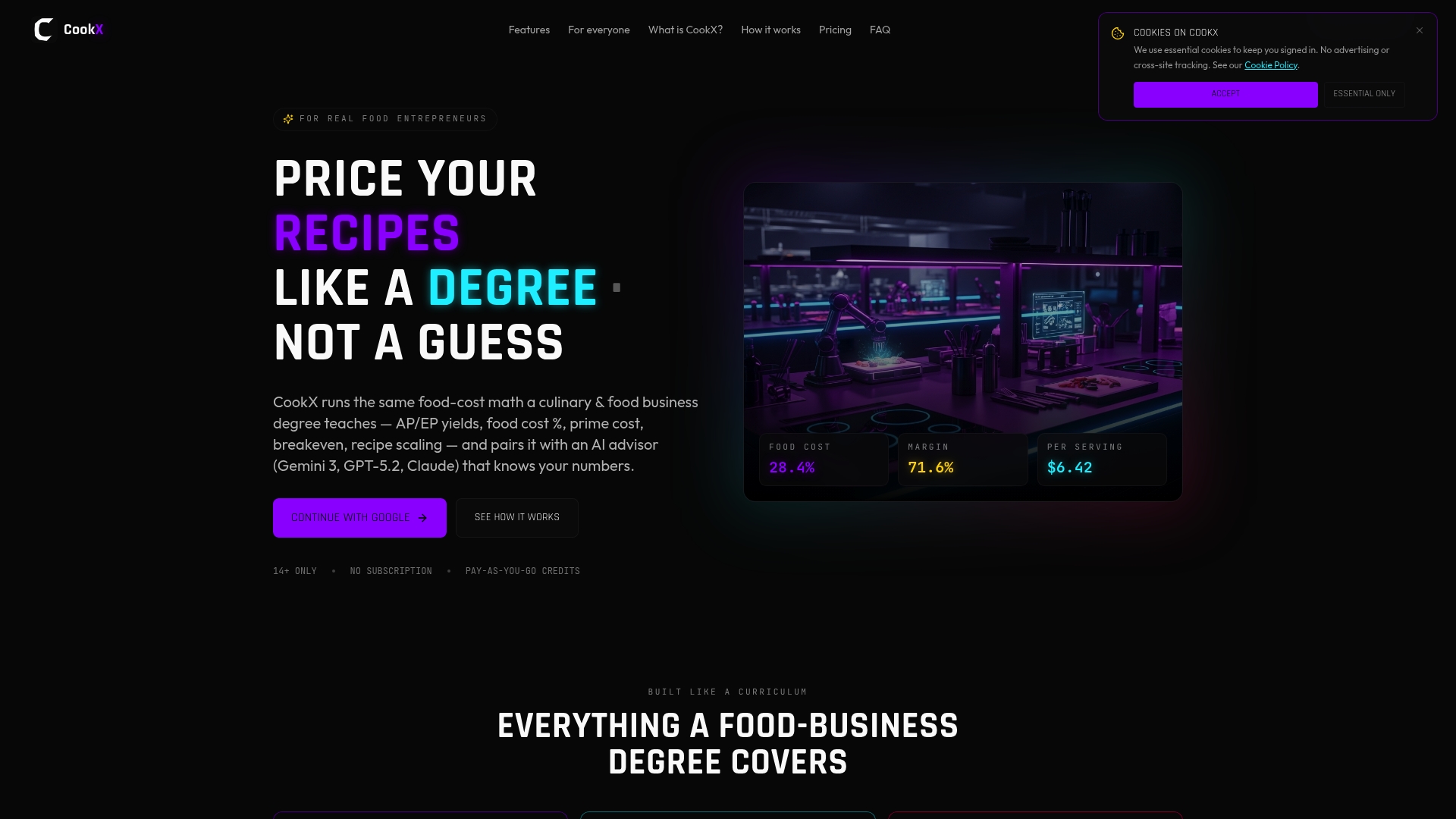
The platform applies culinary school-level food cost mathematics, so the 28–35% food cost benchmark and spoilage buffer calculations are built into how it works. You can test different guest count scenarios, adjust service styles, and see how your price floor shifts instantly. For caterers managing multiple events with overlapping menus, the recipe and cost dashboard keeps every dish's cost data organized and accessible. No subscription required. You pay for what you use, which makes it practical for both high-volume operations and planners who need accurate numbers for a single high-stakes event. Explore the full calculator suite and see how much faster costing gets when the math handles itself.
FAQ
What is the target food cost percentage for catering events?
Catering food cost benchmarks target 28–35%, with an additional 5–10% added for trim, spoilage, and over-portioning. Divide your raw cost per head by your target percentage to find your minimum price floor.
How do I account for re-fire risk in multi-course event costing?
Build a re-fire liability table for each hot main dish listing re-fire time and expected rate. At a 3% re-fire threshold for a 200-person event, budget for six additional full portions of ingredients and labor as a cost line item.
How early should I lock in guest count for food cost budgeting?
Budget at 80% of projected attendance initially with a 10–20% contingency, then update weekly as RSVPs confirm. This protects your cost floor without over-purchasing.
Does service style really change food cost calculations?
Yes, significantly. Buffet service requires planning for second servings and popular dish shortfalls, while plated service offers portion control but generates uneaten course waste. Your portion assumptions and purchase quantities change for every course depending on the format.
What KPIs should I track after a multi-course event?
Track food cost percentage per course, labor cost per cover, re-fire rate per hot dish, and consumption variance against your projection. Flag any line item exceeding its projection by 10% and document the cause for future planning.